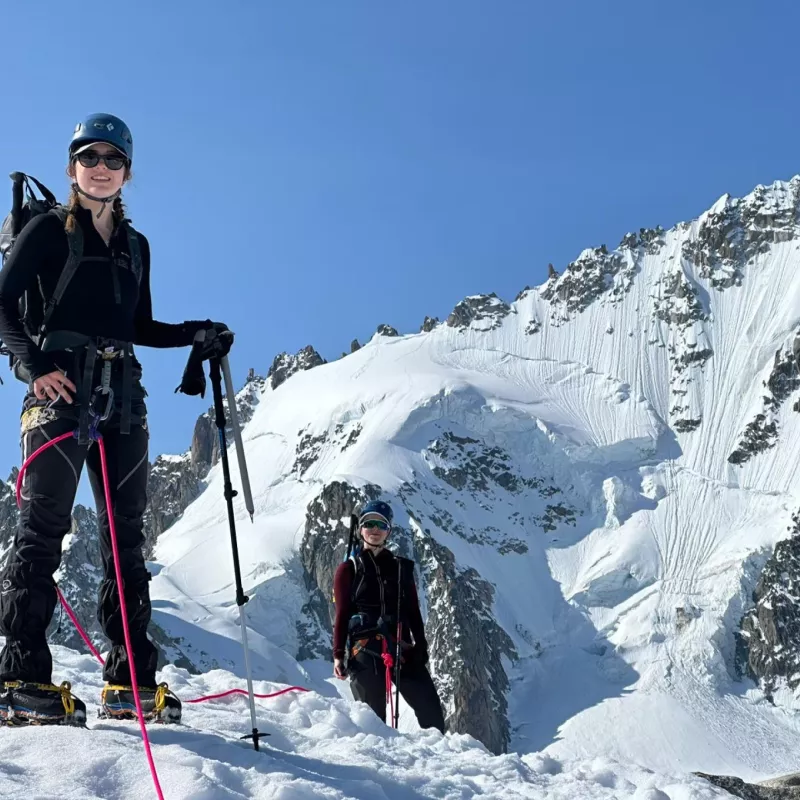
The 7 best hut-to-hut ski touring routes in the Alps
In the Alps, certain routes have become true classics. The Haute Route Chamonix–Zermatt naturally tops this list thanks to its history, its scale and the exceptional quality of the landscapes it passes through. However, other ski tours deserve just as much attention: the Grand Paradis for its summit at over 4,000 metres, the Silvretta for the quality of its touring, the Meije for its technical challenge, and the Cerces for discovering ski touring in a more accessible environment.
How do you choose between these routes? The number of days and the elevation gain alone are not enough. You need to consider your off-piste skiing ability, your ski touring experience, your stamina, the altitude, glacial terrain, technical sections and your ability to sustain the effort.
Here is our selection of the best hut-to-hut ski tours in the Alps, ranked according to their reputation, their alpine appeal and their suitability for different types of skier.
Comparison of the best ski tours in the Alps
| Ski Tour | Mountain Range | Approx. Duration | Level | Main Character | Best suited for |
| 1. Chamonix–Zermatt Haute Route | Mont Blanc Massif & Valais | 6 to 7 days | Performance | Iconic high-altitude glacier ski tour | Experienced ski tourers aiming for the ultimate Alpine classic |
| 2. Gran Paradiso | Aosta Valley | 5 days | Performance | Glaciers and a 4,061 m summit | Strong ski tourers looking to combine a multi-day tour with a 4,000 m peak |
| 3. Silvretta | Austrian Alps | 6 days | Advanced | Hut-to-hut touring and glaciers | First major Alpine ski tour or experienced intermediate ski tourers |
| 4. Tour of La Meije | Écrins Massif | 4 days | Expert | Technical ski mountaineering | Highly experienced skiers seeking technical terrain and commitment |
| 5. Grande Lui Haute Route | Mont Blanc Massif & Valais | 7 days | Expert | Wild and demanding Haute Route | Experts with solid previous multi-day ski touring experience |
| 6. Les Cerces | Southern French Alps | 5 days | Advanced | Wild and progressive | An excellent choice for a first hut-to-hut ski tour |
| 7. Grand Saint-Bernard | Valais & Aosta Valley | 3 days | Advanced | Short multi-day ski tour | First experience of hut-to-hut ski touring |
These levels are for guidance only. In the high mountains, the actual difficulty of an expedition depends as much on snow and weather conditions as on the route itself.
How do you choose your ski tour from hut to hut?
Two tours with a comparable daily elevation gain can be radically different. Climbing 1,000 metres over relatively straightforward terrain is nothing like a day involving a glacier, steep traverses, crampon use, carrying your skis and exposed sections.
The first question therefore concerns your off-piste skiing ability. A skier who performs very well on the piste is not necessarily ready for a week-long ski tour. You need to be able to ski efficiently in changing snow conditions – which may be crusty, hard, deep or transformed – whilst carrying a rucksack and after several hours of exertion.
Next comes experience on the ascent. Side-stepping must be safe and energy-efficient. Transitions must be mastered. Depending on the route, you must also know how to use ski crampons, ice crampons and an ice axe.
Endurance is just as crucial. The difficulty of a ski tour lies in the repetition of the effort. A six- or seven-hour day may well be perfectly manageable. But doing this for five, six or seven days in a row requires a different level of preparation.
Finally, a distinction must be made between ski touring and ski mountaineering. Long glacier treks present additional challenges: crevasses, roping up, navigation, technical passes, altitude and, at times, walking sections.
To help you progress gradually from day trips to multi-day treks, Chamonix Experience offers several ski treks in the Alps, ranging from advanced courses to expert programmes.
1. Haute Route Chamonix–Zermatt: the gold standard of alpine ski treks
Skiing from Chamonix to Zermatt remains one of the greatest mountain journeys a ski mountaineer can undertake. The Haute Route’s reputation is not based solely on its long history. It stems from a rare combination: two capitals of mountaineering, several major mountain ranges, vast glaciers, high-altitude passes, iconic mountain huts and a finish line facing the Matterhorn.
The Haute Route was first tackled as an alpine route before becoming one of the great ski traverses of the Alps. It is now known throughout the world and attracts skiers from Europe, North America and beyond.
Depending on the package and route variant chosen, the Haute Route generally takes 6 to 7 days. Chamonix Experience offers several options for travelling from Chamonix to Zermatt, taking in a true high-mountain landscape.
Why the Chamonix–Zermatt route remains a unique expedition
The start in the Mont Blanc massif immediately sets the tone for the adventure. The journey then gradually shifts towards the vast open spaces of the Valais.
The classic Haute Route crosses areas that have become legendary in ski mountaineering. Depending on conditions and the chosen route, the journey may take in Argentière, Trient, the Rosablanche, the Cabane des Dix, the Pigne d’Arolla, the Cabane des Vignettes, Bertol and Tête Blanche before the descent to Zermatt.
The appeal lies not simply in ticking off the passes. What makes the Chamonix–Zermatt route so special is the continuity of the journey. Each day takes you further from the starting point and gradually builds up the crossing.
The finish is one of the highlights. After several days at high altitude, descending into Zermatt with the Matterhorn towering over the horizon truly gives you the feeling of having skied across part of the Alps.
Chamonix Experience details its various packages on its page dedicated to the Haute Route on skis and presents the full programme for the guided Chamonix-Zermatt Haute Route.
What level of ability is required to ski the Haute Route?
It is important to clear up a common misunderstanding: the Haute Route is not a route for learning ski touring.
Participants must already be proficient with skins, have mastered their turns and be comfortable skiing off-piste in various snow conditions. Their stamina must be sufficient to cope with long days for almost a week.
In its current programme, Chamonix Experience classifies the Haute Route as ‘Performance’ level, with a stamina rating of 5/5. The traverse also requires genuine experience of high-altitude mountains and glacial terrain.
Preparation must therefore be planned several months in advance. Building up vertical distance is useful, but working on consistency, turns, transitions and skiing in difficult snow conditions is just as important.
Why undertake the Chamonix–Zermatt route with a guide?
On a long-distance ski tour, the guide’s role goes far beyond navigation.
They must interpret snow conditions, anticipate weather changes, set timetables, choose alternative routes, manage the group on glaciers and know how to adapt the itinerary when conditions require it.
In the high mountains, sticking to the planned route at all costs is never the objective. Making the right decision at the right time is an integral part of the ski tour.
It is precisely this ability to adapt that makes a high-mountain guide’s experience so valuable.
2. Gran Paradiso: a ski tour featuring a 4,000-metre summit
The Gran Paradiso massif offers a markedly different experience. Here, a tour involving overnight stays in mountain huts can culminate in the ascent of a true 4,000-metre summit.
The Grand Paradis ski tour organised by Chamonix Experience takes place over five days, with four nights in mountain huts. The programme is classified as ‘Performance’ and requires excellent physical fitness.
The summit of Grand Paradis reaches 4,061 metres. This altitude adds an extra dimension to the trip: managing exertion, acclimatisation, glacier traversing and ski-mountaineering techniques.
The massif also has a very distinct character. Situated in the Aosta Valley and protected by the Gran Paradiso National Park, it combines glacial landscapes, Italian valleys and high mountains.
This is the trip for you if your aim is to combine a genuine ski touring adventure with the ascent of a summit over 4,000 metres.
3. Silvretta: a great classic of the Austrian Alps
The Silvretta is an excellent alternative to the major ski tours of the Western Alps. Situated between Austria and Switzerland, this mountain range offers terrain particularly suited to ski touring, with numerous peaks exceeding 3,000 metres and an extensive network of mountain huts.
The appeal of this tour lies in its balance. It offers a genuine glacial environment and a wonderful sense of adventure, without necessarily requiring the technical challenge of a Tour de la Meije or a Grande Lui.
The ski tour in the Silvretta organised by Chamonix Experience takes place over six days. It is also an opportunity to discover a different mountain hut culture, as Austrian huts are renowned for their hospitality and comfort.
The Silvretta is therefore an excellent choice for entering the world of long-distance alpine ski tours before setting your sights on a challenge such as Chamonix–Zermatt, provided you possess the necessary technical skills.
4. Tour de la Meije: when a ski tour becomes ski mountaineering
Switching mountain ranges to head for the Écrins also means a change of atmosphere. Around La Grave and La Meije, the terrain becomes rockier, steeper and often more technical.
The Tour de la Meije ski touring trip organised by Chamonix Experience takes place over four days. Its relatively short duration should by no means be taken as a sign that it is easy.
Glaciers, steep slopes, couloirs and sections requiring ropes, crampons and ice axes give the route a genuine ski mountaineering feel. The programme is, in fact, classified as Expert.
The first section also offers the chance to ski in La Grave, an international mecca for freeriding, before venturing into the more remote parts of the massif.
The Tour de la Meije is aimed at skiers seeking technical challenge and commitment rather than the sheer length of the trek. Previous experience with crampons, glacial terrain and alpine techniques is essential.
5. Grande Lui Haute Route: a wilder and more demanding Haute Route
For skiers with previous experience of glacier expeditions, the Grande Lui Haute Route is one of the most interesting routes in this selection.
This variant also links the Chamonix region with Zermatt, but in a different spirit to the classic Haute Route. Chamonix Experience describes it as a more demanding and less frequented variant, with the entire route covered on skis without the use of taxis or ski lifts.
The physical and technical challenge is therefore significantly stepped up. The terrain requires a solid command of ski mountaineering, crampon use and high-mountain techniques.
La Grande Lui is aimed at those who are no longer simply looking to ‘do a Haute Route’, but who want to experience a more purist, more continuous and more demanding traverse.
This is typically a challenge to consider after a successful first experience of a hut-to-hut ski tour.
6. Les Cerces: one of the best first ski expeditions
Not all skiers are suited to starting with a major glacial expedition. The Cerces massif provides an excellent transition between day-long ski touring outings and multi-day expeditions.
The ski expedition in the Cerces takes place over five days and four nights in mountain huts. Chamonix Experience explicitly recommends it as a first expedition.
The massif, situated in the Southern Alps near the Italian border, offers a remarkable variety of terrain. Limestone landscapes alternate with steep slopes and larch forests. The network of mountain huts also makes it fairly easy to adapt the itinerary to a group’s ability level.
Each day generally requires the ability to cover an elevation gain of around 600 to 1,000 metres. You must already know how to use ski touring equipment, change bindings and ski off-piste.
Les Cerces are accessible to experienced skiers, yet wild enough to give you the feeling of embarking on a genuine ski expedition.
7. Grand Saint-Bernard: three days to discover ski touring
Before booking a six- or seven-day tour, some skiers prefer to test their ability to manage several consecutive days with nights in mountain huts.
The ski touring route around the Grand Saint-Bernard is particularly well suited to this purpose.
Three days of skiing and two nights in a mountain hut allow you to experience the unique rhythm of ski touring without immediately committing to a full week.
The area also boasts a remarkable location between Valais and the Aosta Valley, in a region deeply linked to the history of Alpine crossings.
The trip remains manageable in terms of duration, but it is not suitable for complete beginners. Some prior experience of ski touring, skinning and off-piste skiing is essential.
It is an excellent trial run before embarking on a longer tour in the Cerces, the Silvretta or, later on, the Haute Route.
Other major ski touring routes in the Alps
The selection could, of course, be expanded. The Monte Rosa massif offers exceptional high-altitude tours amidst a remarkable concentration of peaks over 4,000 metres. The routes in the Queyras favour a different style of journey, winding through larch forests, over mountain passes, through villages and past mountain huts, with generally fewer glacial sections. The Vanoise, for its part, offers numerous ‘hut-to-hut’ combinations and allows you to plan traverses of very different levels of difficulty.
There is therefore no single ‘best ski tour’. The best route is, first and foremost, the one that matches the skier’s technical ability, fitness level and aspirations.
To explore the various options, the Chamonix Experience ski tours page allows you to compare the programmes on offer across several Alpine massifs.
Which ski tour should you choose based on your level?
For a first backcountry experience, the Cerces or a short tour around the Great St Bernard Pass are sensible choices.
The Silvretta then offers a full immersion into the world of major Alpine ski tours and glacial terrain. The Grand Paradis adds altitude and the challenge of a 4,061-metre summit.
The Chamonix-Zermatt Haute Route is a major milestone for the already experienced skier. Finally, the Tour de la Meije and the Grande Lui are aimed at skiers seeking significantly more technical or demanding terrain.
The logical progression is therefore not to immediately seek out the most prestigious tour, but to build up your experience gradually.
When is the best time for a ski tour in the Alps?
For major high-altitude tours, the period from late winter to spring is generally preferred. This coincides with the opening of many staffed mountain huts and days that are long enough to cover significant distances.
But basing your decision solely on the calendar would be a mistake.
Snow cover, wind, temperatures, the condition of the glaciers, night-time freezing and changes in the snowpack determine the actual conditions. Two weeks that appear identical on the calendar can present radically different situations from one year to the next.
On long routes, the weather window and mountain conditions always take precedence over the planned itinerary.
This is also why a planned route must remain flexible. Changing mountain huts, taking an alternative route or even abandoning the trip altogether may be the best decision of the week.
How do you prepare physically for several days of ski touring?
Preparing for a ski tour isn’t just about being able to manage a long day’s skiing.
You need to learn to sustain the effort. For an intermediate-level route, being comfortable over several days with 800 to 1,000 metres of elevation gain provides a far more relevant foundation than occasionally managing a 1,500-metre ascent at the cost of significant fatigue.
On more demanding multi-day tours, some days can be much longer.
Preparation must therefore combine basic endurance, elevation gain, off-piste skiing and technical efficiency. The smoother the transitions between skiing and walking, the less energy they consume.
The aim is not to arrive at the mountain hut exhausted. You need to conserve enough energy to set off again the following morning.
What equipment is needed for a ski tour to a mountain hut?
The equipment depends on the terrain, but the desire for lightness must never come at the expense of safety or reliability.
For a major alpine ski tour, the equipment generally includes:
- tried-and-tested touring skis and boots, skins, crampons, an avalanche transceiver, a shovel, a probe, a helmet (depending on the route), mountaineering crampons, an ice axe and a harness where the terrain requires it, breathable and protective clothing, spare gloves, goggles suitable for high-altitude mountaineering, a head torch, a mountain hut blanket, water, energy food and a small personal kit.
On glacier routes, group equipment and roping-up gear are also essential.
The best backpacking rucksack is not the one that contains everything that might possibly be needed. It is the one that contains exactly what is necessary.
Lightweight kit that the skier knows inside out makes a considerable difference after four or five days of backpacking.
Why set off with a high-mountain guide?
On a glacier route, simply knowing the route is not enough to guarantee safety.
A guide must interpret the snowpack, monitor weather conditions, assess glacier crossings, choose the departure time and adapt the pace to the group’s abilities.
On a Haute Route, this expertise also extends to logistics. Mountain huts, any ski lifts, transfers, route changes and contingency plans are all part of a successful crossing.
Chamonix Experience organises guided ski tours in the Alps with UIAGM-certified high-mountain guides. The agency is based in Chamonix, at the foot of the Mont Blanc massif, which gives it a particularly detailed knowledge of the starting terrain of the Haute Route.
This experience really comes into its own when the mountain conditions do not match the planned itinerary.
A successful multi-day ski tour is not one where the itinerary has been followed at all costs. It is one where the right decisions have been made every day.
From the first mountain hut to Chamonix-Zermatt
A multi-day ski tour often represents a decisive step in a ski tourer’s journey. You learn to manage your effort differently, to travel lighter, to pay closer attention to conditions and to accept that the mountains dictate their own pace.
Les Cerces or the Great St Bernard Pass offer an introduction to this way of thinking. The Silvretta opens the door to a true glacial trek. The Gran Paradiso introduces the altitude of a peak over 4,000 metres. The Chamonix–Zermatt Haute Route then brings together many of these skills in one of the most famous ski tours in the Alps.
And for the most experienced skiers, the Meije or the Grande Lui offer even greater technical challenge and commitment.
The Haute Route remains a benchmark, but it takes on even greater significance when it forms part of a skier-mountaineer’s coherent progression.
To prepare for this challenge, explore the various Haute Route ski packages or compare all the ski tours offered by Chamonix Experience; the choice must begin with a realistic assessment of your experience, skiing ability and physical fitness.
FAQ
What is the most famous ski tour in the Alps?
The Haute Route Chamonix-Zermatt is probably the most iconic ski tour in the Alps. Its international reputation stems from its history, the journey between two mountaineering capitals, the crossing of major glaciers and its spectacular finish beneath the Matterhorn.
How many days does it take to ski the Chamonix–Zermatt Haute Route?
You should generally allow 6 to 7 days, depending on the package and route variant. The detailed programme currently offered by Chamonix Experience runs over seven days, whilst various other Haute Route packages and route variants can be organised.
What level of skiing is required for the Haute Route?
The Haute Route requires solid experience of ski touring. You must be efficient on the ascent, have a good command of snowplough turns, be able to ski off-piste in different snow conditions, and possess the stamina needed to cope with long days. Familiarity with high-mountain techniques is also important due to the glacial terrain.
Which ski tour should you choose for your first hut-to-hut experience?
The Cerces is one of the best choices for your first proper hut-to-hut ski tour. The three-day Grand Saint-Bernard route also allows you to try out ski touring before committing to a longer programme. However, you must already have some experience of ski touring.
What is the difference between ski touring and ski mountaineering?
Ski touring mainly involves ascending on skis using skins and then descending. Ski mountaineering incorporates techniques from mountaineering: progressing with crampons and an ice axe, roping up, glacier or mixed terrain sections, carrying skis and, at times, tackling steeper or more exposed slopes.
How much elevation gain should you be able to manage before a ski tour?
The figure depends on the itinerary. For many ski tours, being able to consistently cover 800 to 1,000 metres of vertical ascent without ending up exhausted is a good baseline. Demanding routes may require much more. The ability to sustain this effort over several consecutive days is more important than a record vertical ascent achieved in a single outing.
When is the best time of year for the Haute Route?
The usual season is generally in spring, and the Chamonix Experience programmes are offered in particular in March and April. However, actual snow and glacier conditions, the weather and the opening of mountain huts remain the deciding factors.
Can you go on a ski tour without a guide?
A truly self-sufficient ski mountaineer can organise certain tours without a guide. However, this level of self-sufficiency requires mastery of snow science, navigation, glacier travel, crevasse rescue, roping-up techniques and decision-making in alpine terrain. On major glacier tours, being accompanied by a guide provides technical expertise and the ability to adapt, both of which are particularly important.
Which tour should you choose after the Chamonix–Zermatt Haute Route?
To increase the level of challenge, the Grande Lui Haute Route is a particularly logical next step. The Tour de la Meije offers another progression, more focused on technical ski mountaineering, with couloirs and sections requiring crampons, an ice axe and a rope.
Is the Haute Route suitable for a good skier who is new to ski touring?
No. Being an excellent alpine or off-piste skier provides an excellent foundation, but is no substitute for ski touring experience. Before tackling Chamonix-Zermatt, it is best to have completed several long outings and, ideally, a first hut-to-hut ski tour.