How do you prepare for the ascent of Mont Blanc?
Mont Blanc is one of those summits that attract as much as they impress. With its altitude of 4,806 metres (in 2026), the ‘simple’ normal route is not a long hike: it’s a real high-mountain mountaineering race. This ascent requires commitment, managing the effects of altitude, glacier climbing and adapting to changing conditions.
The key to success lies long before the first step onto the snow: in physical preparation, acclimatisation, logistics, equipment management and safety strategy.
What are the real demands of Mont Blanc (and why do many underestimate them)?
Climbing Mont Blanc combines three mutually reinforcing difficulties: duration of effort, altitude and glacial terrain.
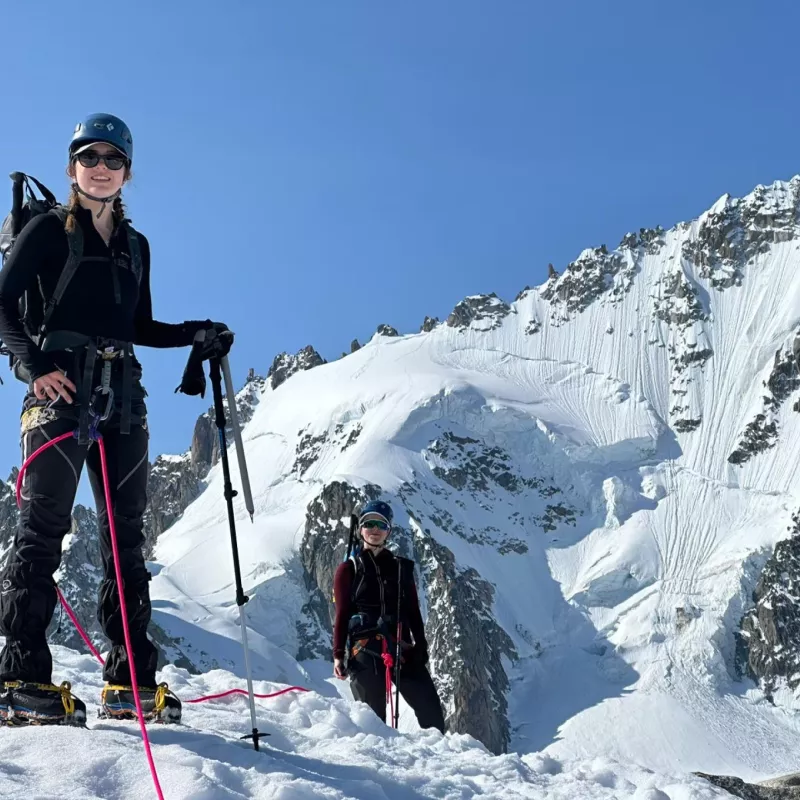
Even on a “classic” route, the schedule is often nocturnal, and the progression is made with crampons on, roped up on the glacier, with fatigue increased by hypoxia.
In the high mountains, performance is not just a question of ‘being sporty’. Above all, you need to be enduring, regular and efficient. Aspiring climbers must be able to maintain a steady pace for several hours, sometimes in the cold, sometimes in the wind, and almost always with a sleep debt.
Key point: altitude amplifies everything. A little lack of preparation at 1,500 m becomes a real problem at over 4,000 m.
Itineraries: normal route, Trois Monts, Italian route… the choice is never ‘theoretical’.
Depending on the season, the snow cover, the stability of the snowpack, the number of climbers and your profile, the routes do not present the same risks (rockfalls, avalanches, crevasses, seracs) or the same technical requirements. Chamex can guide you through several courses : Ascent Mont Blanc via the italian way. , or the Monte Rosa and Mont Blanc Combined Ascent Course.
A serious programme always includes options and the ability to adapt: that’s one of the main reasons for having a guide.
Acclimatisation: the difference between “having the legs” and ‘having the lungs
Altitude is a merciless filter. You can be highly trained on the plains and find yourself in difficulty above 3,500-4,000 m. Acclimatisation aims to limit the symptoms of hypoxia and improve your performance at high altitude.
Understanding the warning signs
Persistent headaches, nausea, loss of appetite, trouble sleeping, abnormal breathlessness, loss of coordination: these signs need to be taken seriously.
The safest rule remains simple: if the symptoms worsen, you go down.
An effective acclimatisation strategy
Acclimatisation cannot be improvised the day before. It is built up by a gradual ascent, with nights at intermediate altitude and, ideally, preparatory summits.
Well-thought-out guided programmes often include one or more acclimatisation runs before attempting the summit, to increase your chances of success and reduce the risk of discomfort.
Remember: ‘climbing slowly’ is not a question of comfort: it’s a strategy for safety and efficiency.
Logistical preparation: refuges, timing, transport, margins
On Mont Blanc, logistics are not an administrative detail: they are a component of safety. The refuges are in great demand, places are limited and the itineraries require strict organisation (departure times, breaks, sequences).
Booking mountain huts: plan ahead
Depending on the route, you’ll pass some emblematic refuges. For example, on the voie normale, the route is popular and places are booked up months in advance. The booking procedure for the Goûter refuge is governed by the FFCAM. Peak periods also require bookings to be made well in advance.
Not knowing this often leads to cobbled-together plans, inconsistent timetables, or excessive fatigue (too much ascent all at once).
Why management really makes logistics easier
An experienced operator like Chamex can integrate the management of the refuges, adjust the route according to the conditions, and propose coherent solutions if a parameter changes (weather, state of the route, availability).
In practical terms, this avoids turning logistics into stress and allows you to concentrate on preparation and progress.
What mountaineering equipment to choose for Mont Blanc (and how to avoid the classic mistakes)
On Mont Blanc, equipment must meet three requirements: safety, reliability and efficiency. The right equipment is not the most ‘high-tech’, it’s the one that you know how to use and that is adapted to the conditions.
One of the most common mistakes is to buy too much, too late, without testing.
Essential checklist (to be tested before setting off)
- Crampon-compatible mountaineering boots (suitable stiffness) + tested technical socks.
- Crampons adjusted to your boots + gaiters – suitable ice axe.
- Harness, helmet, lanyard, karabiners, and safety system depending on supervision.
- Layered clothing (breathable base, insulation, protection) + warm gloves / technical gloves, hat, neck protector.
- Ski mask or category 4 goggles + high-protection sun cream.
- Powerful headlamp + spare batteries.
- Optimised bag (neither too big nor too small) + water/thermos + power supply that can be used in the cold.
Choosing without overloading: the right weight in the right place
A bag that is too heavy will reduce your pace and increase fatigue, especially at altitude. Conversely, a bag that is “too light” without gloves or suitable clothing can become a safety problem.
The most reliable approach is to aim for consistent equipment that has been tested and adjusted by a professional (particularly with regard to shoe/crampon compatibility and cold management).
Key point: the best equipment is the one you’ve already used in real conditions, not the one you discover on D-day.
Prepare yourself mentally: managing the pace, the cold, keeping your wits about you
Mental preparation for Mont Blanc is not an abstract “motivation”. It’s the ability to remain effective when fatigue sets in: eating well despite the altitude, staying hydrated, managing discomfort, maintaining a clean technique and listening for weak signals.
Supervision also plays a role here: a guide structures the effort, imposes a realistic pace, corrects bad habits (too fast, too many long breaks, lack of hydration), and reassures decision-making.
Frequently asked questions about preparation and the climb
How difficult is Mont Blanc?
Mont Blanc is not as “technical” as some of the big faces, but it is demanding because of the combination of altitude + time + conditions + glacial terrain.
The actual difficulty varies greatly depending on the route and the conditions: hard snow, wind, cold, rock falls, number of people on the route, state of the snow bridges, etc.
It can be summed up as follows: technically accessible to a properly trained mountaineer, but physically and mentally selective, especially above 4,000 m. You can improve your skills with Mountaineering courses in Chamonix.
Is it possible to climb without training?
That’s a very bad idea. Even if some people “pass” thanks to a strong mind and a good day out, the absence of training greatly increases :
cardio drift, fatigue, handling errors, the risk of altitude-related discomfort and the likelihood of having to give up late (and therefore tired).
High mountains don’t tolerate improvisation: training is an investment in safety, not just in reaching the summit.
How long does it take to prepare properly?
For an already active climber, we generally aim for a structured cycle of 12 to 16 weeks, with a progression in volume, ascent and specificity.
For a profile less accustomed to endurance training, you should allow 4 to 6 months to build up a solid base without injury.
In all cases, the best indicator is not the duration of the plan, but your ability to link together long mountain outings while remaining regular and clear-headed.
When is the best time to attempt Mont Blanc?
The “classic” period is in summer, but the quality of the conditions varies enormously from week to week.
A “good time” isn’t a date on a calendar: it’s a consistent weather window, acceptable route conditions and sufficient stability.
This is precisely where local expertise and programme adaptation become decisive.
Is it dangerous?
Yes, like any high mountain race. The risk cannot be eliminated, but it can be reduced: physical preparation, acclimatisation, suitable equipment, mastery of technique, choice of conditions and the decision to give up if necessary.
Accidents are often the result of a combination of fatigue + deteriorating weather + late arrival + handling errors + underestimation of altitude.
A guided, gradual ascent is designed precisely to avoid this scenario.
What is the practical advantage of a ‘progressive’ guided programme rather than a very short format?
A short format may be appropriate for a mountaineer who is already prepared, but it leaves less room for acclimatisation and adaptation.
A progressive programme allows you to :
build up technical reference points (cramponing, roping, pace),
acclimatise more effectively,
and increase the chances of success in the right conditions.
This is often the most rational approach for motivated enthusiasts who want to succeed without burning out the stages.
How do I know whether to choose a 3-day, 4-day, 6-day (or longer) climb?
The main criterion is not ‘your motivation’, but your initial level (glacier experience, ease with crampons/harness, ascent endurance) and your history at altitude.
The more specific experience you lack, the more judicious a progressive format will be.
The formats offered by organisations like Chamex exist precisely to adapt to different profiles. The 6-day Mont Blanc ascent programme is recommended for candidates with little experience, and includes acclimatisation and preparatory summits. The 3-day course to climb Mont Blanc is reserved for experienced mountaineers.
Conclusion: prepare methodically and leave yourself room for decision
Preparing for Mont Blanc means accepting the logic of mountaineering: build up your endurance, take care with acclimatisation, master your equipment, secure your logistics and leave yourself some room for decision.
The summit is never guaranteed, but serious preparation maximises your chances and transforms the experience into real progress.
Chamonix Experience offers formats adapted to different levels, with UIAGM/IFMGA guides, a safety-oriented approach, and an organisation that takes into account the practical constraints of the high mountains (conditions, refuges, timing).
One last essential point: success also means knowing when to give up. In the high mountains, this skill is worth as much as a summit.